
The Future of Gaming Screens: What Will Really Change
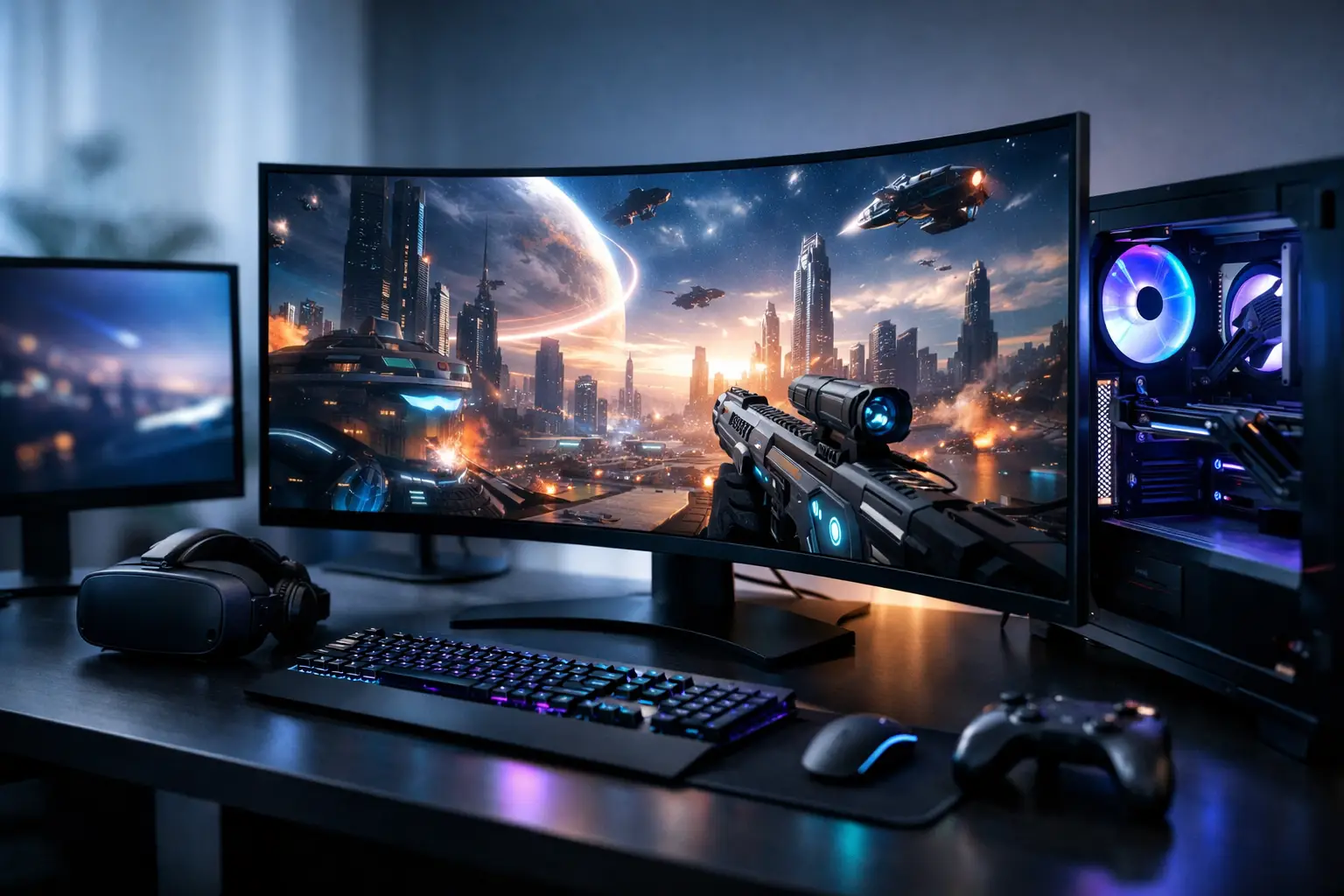
Today, anyone purchasing a gaming monitor is looking for more than just a high refresh rate panel. The future of gaming monitors is now determined by a combination of display technology, connectivity, GPU requirements, and even the types of games you actually play. That's why the right question isn’t just "how many Hz?" but rather which monitor will remain relevant in two or three years.
The market moves quickly, but not every change is revolutionary. Some innovations genuinely enhance sharpness, responsiveness, and contrast, while others look good on paper but offer only marginal improvements for the price. For those comparing models before buying, it’s essential to understand where the future of gaming monitors provides real value and where it’s better to make a smart purchase now rather than waiting for the next generation.
The Future of Gaming Monitors Starts with the Panel
If there’s one area where the change is most evident, it’s the type of panel. For years, the choice was relatively straightforward: TN for speed, IPS for balance, and VA for contrast. Today, the picture is much more complex and, importantly, much more interesting.
OLED continues to take center stage in the premium category. The reason is clear – true black, incredibly fast response times, and images that appear sharper and more vibrant in almost every game. In competitive gaming, this is felt in motion, while in single-player games, it translates to overall image quality. The downside is the price, and in some cases, there's concern about burn-in with prolonged static use. For gamers who also do office work for hours, this is still a valid consideration.
Mini-LED is another, equally significant direction. It doesn’t offer the same pixel-level control as OLED, but it does provide extremely high brightness, enhanced HDR, and often a more accessible price point. These screens are particularly suitable for those who want general use, gaming, and better compatibility in well-lit rooms. In simple terms, not everyone looking to the future needs to transition to OLED.
IPS is far from obsolete. In fact, for many buyers, a quality IPS panel with a high refresh rate remains the most balanced choice. It doesn't provide the contrast of OLED or the powerful HDR effect of Mini-LED, but it delivers good images, decent response times, and more competitive prices. This is especially significant when building a complete gaming setup, as you need to budget for the computer, graphics card, keyboard, and headphones.
Refresh Rates Will Continue to Rise, but Not Everyone Will Benefit
Once, 144Hz was considered a significant upgrade. Now, we see 240Hz, 360Hz, and even more. On paper, this seems like a clear direction, but the actual benefits depend greatly on the type of user.
For competitive FPS gamers, every increase in refresh rate can be relevant, provided the computer can also deliver matching FPS. A 360Hz monitor doesn’t offer a real advantage if your system runs at only 170-200 frames in major games. Therefore, the future of gaming monitors is not just about the screen itself, but also about the compatibility between the monitor, CPU, GPU, and resolution.
For most users, 144Hz to 240Hz is still the range that provides an excellent gaming experience. Beyond that, the improvement is present, but it’s less dramatic compared to the increase in price. Those who primarily play open-world games, RPGs, or use their setup for mixed purposes like work and content viewing will often find a substantial upgrade in a quality panel or good HDR rather than from a few extra Hz.
The Next Resolution Isn’t Always 4K
There’s a tendency to think that the future direction is simply more pixels. This is only partially true. 4K has become more accessible, but it still requires powerful hardware to take advantage of high refresh rates. This is precisely where many buyers realize that QHD remains an excellent solution.
On 27-inch monitors, QHD strikes a very good balance between sharpness, system requirements, and gaming performance. On 32 inches, however, it can appear less sharp for some users, making 4K more sensible. Conversely, with ultra-wide monitors, the question shifts again – as there, the value isn't just resolution but also a wider field of view and a completely different gaming experience.
Thus, when discussing the future of gaming monitors, it's essential to consider the usage scenario. A competitive player might prefer a 24.5 or 27-inch monitor with moderate resolution and high refresh rate, while a player seeking a cinematic experience may favor a 34-inch ultra-wide or 32-inch 4K display. There is no one-size-fits-all answer.
HDR Will Only Be a Real Factor When Execution is Truly Good
One of the more confusing areas in the market is HDR. Many monitors claim HDR support, but not all deliver an experience that justifies the promise. For HDR to be truly noticeable, a combination of sufficient brightness, good contrast, and quality backlight control or a panel capable of displaying true black is necessary.
In the near future, we’ll see more monitors where HDR will no longer just be a line in the specifications. With the relative decrease in prices for OLED and Mini-LED panels, more models will offer HDR that looks good in games and not just in demo videos. Still, buyers today need to be wary of aggressive marketing. Not every HDR logo signifies the same quality.
Connectivity Will Become Part of the Decision, Not Just a Bonus
It used to be sufficient to check for DisplayPort and HDMI. Today, connectivity directly impacts ease of use, especially for those who combine a gaming PC, console, work laptop, and peripherals.
USB-C with charging and video transfer is becoming increasingly relevant, particularly for those wanting to connect a laptop to one monitor for an organized workspace. Built-in KVM is valuable for those switching between two computers. HDMI 2.1 is crucial for consoles and anyone seeking high refresh rates at advanced resolutions. These are no longer niche additions. In new monitors, this is part of whether the product will fit your desk for years to come.
Ergonomics remain crucial too. A stand with height adjustment, rotation, tilt, convenient cable management, and VESA mounts may not sound like futuristic technology, but in everyday use, they have a greater impact than one might think. A good monitor is not only attractive on paper but also comfortable after ten hours in front of it.
AI Won’t Change the Panel, but It Will Affect the Experience
The introduction of AI into the monitor world won’t be as dramatic as the shift to OLED, but it will be noticeable. We’ll see more intelligent image processing, improved upscaling, dynamic display profiles, and automatic adjustments based on content type. In some cases, this will be helpful; in others, it will be more of a marketing layer.
In gaming, the change is likely to come more from graphical cards and frame-generating technologies rather than the monitor itself. However, the monitor plays a role – if synchronization mechanisms, response times, and motion handling are poor, even advanced performance enhancement technologies won’t yield clean results. In other words, the smart future does not diminish the importance of good basic specifications.
So, Should You Buy Now or Wait?
This is the question every buyer asks, and rightly so. The direct answer is that if your current monitor is limiting you now, there's no reason to wait indefinitely. The market will always continue improving. There will always be faster, brighter, or thinner models. The question is whether the current upgrade offers real improvement for you today.
If you currently have an old 60Hz monitor, almost any switch to 144Hz or higher will be a significant jump. If you're already using a quality 1440p and 165Hz IPS monitor, the next step should be more calculated – perhaps OLED, maybe ultra-wide, possibly 4K, or maybe it’s better to invest first in a stronger graphics card. Smart buying is not chasing every trend but identifying which specifications will serve you over time.
For those exploring categories, comparing specifications, and wanting to buy both monitors and peripherals in one place, including computer components, the right approach is to think about the complete system. This is also where a wide selection really helps because it allows for comparisons across price levels, brands, and types of panels without compromising compatibility for needs.
What to Expect in the Coming Years
The clear direction is not one single innovation but the maturation of several technologies simultaneously. OLED will become more accessible, Mini-LED will strengthen in the mid-market, HDMI 2.1 and USB-C will become broader standards, and more screens will offer a good combination of gaming and general use. Meanwhile, we will see a clearer divide between highly competitive monitors and those intended for rich picture experiences.
This means that purchasing will become less about "the best monitor" and more about "the most suitable monitor." Those who understand this will buy more wisely and maintain their budget. And if you’re searching for a new monitor, it’s best to focus on the panel, resolution, refresh rate, and connectivity that fit your hardware and usage – because the future doesn’t belong solely to the newest technology, but to the most precise choice.
- Setting Up a Dual Workstation for Efficient and Comfortable Work
- How to Choose a Mechanical Keyboard for Work, Gaming, and Typing
- What Charger is Right for Your Phone? Here's How to Choose Wisely
- Guide to Buying a Security Camera for Home, Business, and Outdoor Use
- Tablet Repair Lab - When to Repair and When to Replace?
- 5 Akhad Ha'am St., Netanya, Israel

- Phone: +97298821001
- Sunday - Thursday: 11:00 - 24:00
Friday: 11:00 - 16:00
Saturday and holiday: 20:00 - 24:00 - Contact us form

© 2002 - 2026 TopMarket.co.il - Powered by AnyWeb.co.il