

Inkjet Printer vs. Laser Printer - Which is Better?
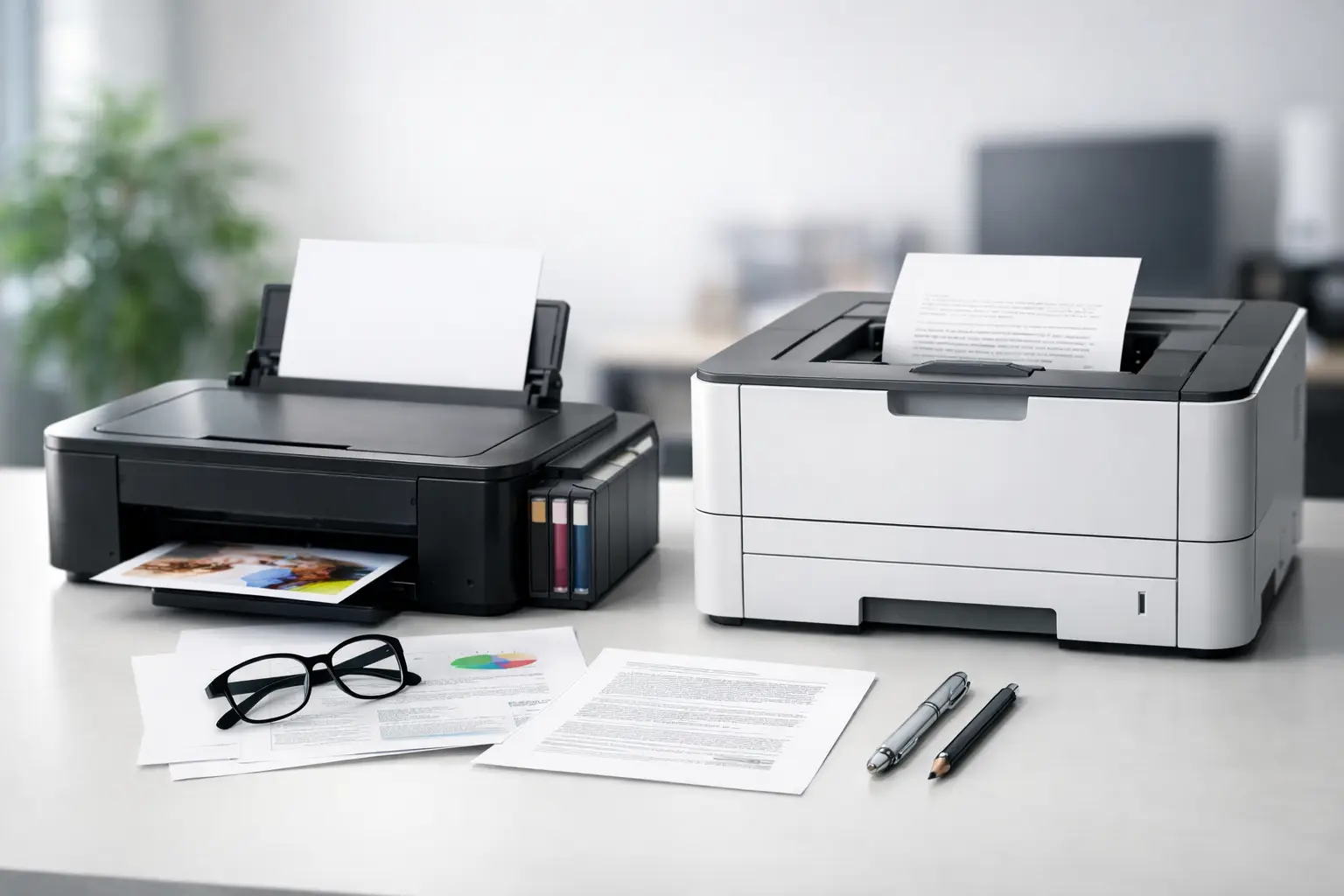
If you find yourself facing dozens of models and asking what truly suits you, the question of inkjet versus laser printers is not merely theoretical. It determines how much you will pay for ink or toner, how quickly you will print, how your documents and images will look, and how much hassle you'll get from maintenance over time. The right choice depends less on the slogan on the packaging and more on your usage habits.
Inkjet vs. Laser Printer - The Basic Difference
An inkjet printer works by spraying tiny drops of ink onto the paper. This technology excels in color, versatility, and printing images. In contrast, a laser printer uses toner and a thermal process that fuses the powder onto the paper. The result is usually faster, sharper text and high efficiency for routine office use.
On paper, it sounds straightforward: images - inkjet, documents - laser. In practice, it's a bit more complex. There are inkjet printers with economical ink tanks that are suitable for high volumes, and there are color laser printers that cost more but provide a stable business solution. Therefore, you need to consider actual usage, not just the type of technology.
Purchase Cost vs. Usage Cost
One common mistake is choosing based solely on the initial price. An inkjet printer is often cheaper to buy up front, especially in entry-level models for home use, students, or casual printing. This choice looks very appealing at the cash register, but in many cases, the ink cartridges are relatively expensive for the amount of printing they provide.
A laser printer typically has a higher upfront cost, especially if you select a wireless model, one with a scanner, or a color printer. On the flip side, the cost per page may be lower, particularly for black-and-white prints at medium to high volumes. In small offices, clinics, law firms, or for anyone who prints many documents, this difference adds up quickly.
Here, it's important to pause at a practical point: if you print ten jobs a month, the cost per page is less critical. If you print hundreds of pages a month, it becomes one of the most important factors. This is exactly why you shouldn't choose a printer solely based on a promotion but rather based on the total cost over time.
Print Quality - Text vs. Images
In any discussion about inkjet vs. laser printers, print quality is a central consideration. A laser printer has a clear advantage in producing crisp, clean, and uniform text. If your primary usage involves contracts, forms, summaries, invoices, or office materials, you will typically see more professional-looking and quicker results.
For photo printing, simple graphic work, children's craft materials, or rich colors, inkjet still holds an advantage in many cases. Soft color transitions and delicate shades can often look better, especially on suitable photo paper. Anyone printing albums, school projects, or colorful marketing materials in small quantities may prefer inkjet.
However, if you don't print images regularly, there's no reason to pay for an advantage you won't utilize. Many users purchase a color printer with an emphasis on images, and in practice, they print 95 percent of their documents as Word or PDF files. In such cases, a black-and-white laser may be the more efficient solution.
Working Speed and Daily Convenience
In daily use, laser printers have a clear advantage in speed. They warm up quickly, produce documents at a high pace, and are better suited for those who are printing continuous pages. This is especially noticeable in an office or home with several users.
Inkjet printers are generally slower, although there are very fast models in advanced categories. For typical home use, this isn't always a problem, but if you're rushing to print 40 pages before a meeting or submission, the difference becomes significant.
Print durability also plays a role. Toner tends to be less sensitive to smudging immediately after printing, which is an advantage for business documents. Inkjet, especially on unsuitable paper, can have situations where drying or smudging will be a concern.
Maintenance, Reliability, and Downtime
This is one of the factors that significantly impacts satisfaction and often gets overlooked in the specifications. An inkjet printer does not always handle infrequent use well. If you print rarely, the ink cartridges may dry out, and then you may find yourself performing head cleaning, wasting ink, and sometimes having to replace cartridges sooner than expected.
A laser printer is generally more forgiving in this regard. If you printed something now and again in two weeks or a month, the likelihood of a problem due to infrequent use is lower. For someone who prints occasionally but wants their printer to simply work when needed, this is a real advantage.
On the other hand, laser printers can be larger and heavier and sometimes more expensive for replacement parts or accessories. Not every home needs a large office machine on the table. If space is limited, you should check dimensions, not just performance.
Who Is an Inkjet Printer Suitable For?
Inkjet is especially suitable for home use, students, families, and users who need true color, scanning, and copying at a low entry price. It’s a good choice for printing assignments, photos, coloring pages, educational materials, or not very high quantities of documents.
It’s also relevant for those looking for integrated models with Wi-Fi, mobile printing, and simple operation without immediately stepping up to a high price category. In models with ink tanks, the picture changes further, since you can achieve a relatively good printing cost even at higher usage volumes.
However, if you print very infrequently, it's vital to choose carefully. A cheap printer that isn’t used can become expensive in maintenance.
Who Is a Laser Printer Suitable For?
Laser printing is particularly suitable for offices, small businesses, students who print a lot of text, and anyone who values speed, clarity, and stability. If black-and-white documents are the primary need, this is usually the most efficient choice.
At home, it can also be an excellent solution, especially for those who print forms, articles, summaries, legal materials, or work documents. In such cases, a black-and-white laser printer provides very good value and reduces ongoing hassles.
A color laser printer caters to a different audience - businesses, advanced users, or those who need both graphics and high volume. It’s not always the most economical choice for home use, but in a business environment, it can save time and maintain a professional level.
Questions to Ask Before Buying
Before looking at brands, print speeds, or promotions, it’s essential to define usage. How many pages do you print per month? Do you need color or just black-and-white? Is mobile printing important to you? Do you need a scanner and copier? And will the printer sit at home with weekly use, or in an office with daily work?
If the usage isn't clear, it's typically better to start with the primary scenario. Those primarily printing text should consider laser. Those printing images, craft work, and color should explore inkjet. Those seeking balance need to consider consumable costs and actual usage volume.
Another important point is the availability of consumables. Even an excellent printer can be less worthwhile if cartridges or toners are exceptionally expensive or hard to find. In smart purchasing, it's essential to evaluate not just the device but the entire system around it.
So What Is the Best Choice?
There is no one-size-fits-all answer because the choice between inkjet and laser printers ultimately depends on work habits. For a home that occasionally prints documents and also wants color, inkjet can be the right solution. For offices, intensive studies, or anyone printing a lot of text pages, laser will generally provide a more efficient experience.
If you’re looking for a safe choice, try to calculate not only what you need today but also how you will use the printer six months from now. Those who choose based on printing needs, material types, and maintenance budgets almost always make better purchasing decisions, which saves money, time, and unnecessary replacements in the future.